personal blog of Gaurav Ramesh
Attention is All They Need - A Series on Human Attention
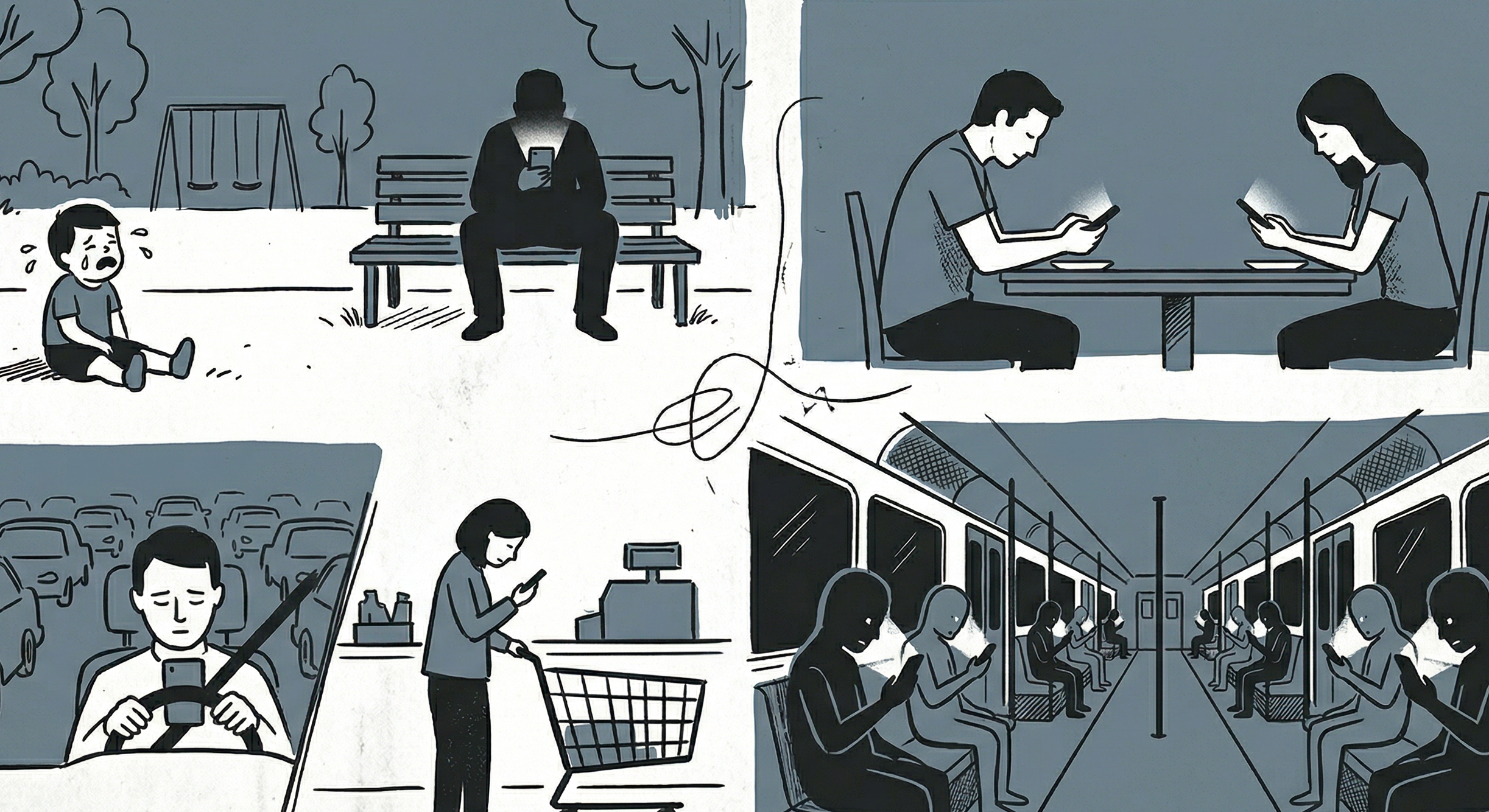
My brother recently told me about an incident at his neighborhood park. A toddler was found crying, lost, looking for his dad. Someone noticed and called out for help. The dad was sitting a few yards away, phone in hand, scrolling, almost as if he had forgotten where he was, and who he was with.
Although intense, in a strange way, it might be the least troubling scene from what's become common in everyday life - because it's visible. The dad would have felt the jolt. The embarrassment would likely correct his behavior, like a near-accident while texting and driving shakes you awake to what's important. The intensity of the moment acts as its own remedy.
What's harder to see - and harder to shake - are the scenes that don't alarm anyone.
A couple at a restaurant, sitting across from each other, both scrolling on their phones. Physically present, emotionally elsewhere. People reaching for their phone in the few seconds they're stuck in traffic, or in the checkout line at a grocery store, as if stillness itself is something to be escaped. A train carriage full of people with their heads buried into their phones like an army of robots trained to do one thing and ears packed with earphones, disconnected from the physical world in every way possible. It's most noticeable in the moment you step inside, just before you automatically reach into your pocket and become one of them.
We know that there's something wrong about this - the way we're glued to our phones. And yet we can't seem to fight it. It's like knowing exactly what goes into a fast-food burger - the suffering of animals killed for it, the chemicals they are fed or treated with, the environmental hazards of industrial farming, the humans exploited for it, the whole ugly picture - and still not being able to stop ourselves from craving it. There's a voice inside us that whispers that it's bad, but there's a force that makes us do it anyway. We feel like we're not in control of our behaviors, yet we're increasingly told that it's a result of our own doing - that we're either ignorant, or that we lack willpower, discipline, or both.
This is an ancient problem. Philosophers called it "akrasia" - acting against your own better judgment, knowing what's right and doing the wrong thing anyway.
By some measures, the global average time spent on social media per user is 2hrs 21mins - roughly 10% of waking hours, and that in the US is 2hrs 09mins.
To put that into perspective: two hours of extra sleep does wonders for our health. Sustained over weeks, it has been shown to sharpen memory, regulate mood, reduce the risk of heart disease, lower cortisol - the stress hormone that makes you anxious, short-tempered, and prone to bad decisions. The irony is that those late hours, in bed, in the dark, are the very hours we reach for our phones most easily. That's not a coincidence.
But the problem isn't just the amount of time. It's the addiction, and more importantly, what we trade for it - attention.
A common thread that emerges through all these behaviors is the fact that we're not paying attention to what we should be. To the humans and non-humans around us, to the physical world we're in.
One of the most common arguments against screen addiction is that it reduces our attention span. I've said it. Believed it. But there's clearly more to it than that because we can manage to binge-watch TV, or doom-scroll for hours. Even toddlers - famously incapable of focusing on anything for more than a few minutes - seem to have no problem watching Cocomelon for an hour straight. That's not a short attention span.
I find it a strange contradiction. We've learned enough about attention to use it to our advantage, at the cost of getting our children addicted - there's a reason parents hand a digital device to their kids in restaurants, on long flights, or while eating. But we haven't learned enough to defend ourselves against the same.
And for all the good reasons I have about why screens are harmful, I have never really understood them. I've parroted them. I hadn't thought seriously enough about why they have the effects that they do, what "attention" even means, why it matters, what happens when we lose control of it, and why so few of us can change our behaviors even when we know something's wrong. My takes, I realized, were formed from unconsciously memorizing various tweet-sized thoughts that I had scrolled past. I suspect that's true for a lot of people.
Attention is one of those words that's so common yet so elusive that it's best answered recursively. Attention is our capacity to pay attention. We know it when we have it, and we notice when we don't. But it's hard to describe it.
This contrast is captured well in the history of attention. William James, in 1890, famously wrote: "Everyone knows what attention is," in The Principles of Psychology. A 2019 paper published in the journal Attention, Perception, & Psychophysics, titled "No one knows what attention is," directly inverted that claim. A century of study had only deepened the mystery.
The word gained new weight in technology circles with a computer science paper called Attention is All You Need. It proposed an architecture for generative AI that made ChatGPT, Claude and Gemini possible. In it, attention is how the neural networks mathematically weigh every word against every other word to "make sense" of the context. I read it and understood the term in that narrow, technical sense.
Then, a few weeks ago, I stumbled upon a paper called Attention is All They Need: Cognitive Science and the (Techno)Political Economy of Attention in Humans and Machines. The title was obviously a play on the first paper - itself carefully chosen to capture attention - but it was looking at human attention. An uncomfortable feeling about my lack of understanding of attention, and our relationship with technology, that had been lurking beneath the surface broke through. The paper immediately piqued my interest. It proposed something ambitious: a rigorous, cross-disciplinary definition of attention, and an argument for what's truly at stake when it's harvested en masse.
I found it extremely engaging, but also demanding, given its academic nature. There were sections that required multiple passes and places where, just as I thought I had built a good understanding, the bigger picture would slip away. I kept at it for two weeks, reading the entire paper at least five times, before it clicked. It was time well spent.
I came out understanding attention in a way that let me reason about our relationship with technology. I understood why the companies do what they do, and why we find it hard to resist. I recognize now when and why I reach for my phone. And I see the deliberate designs in every app, every feed, every interface, meant to maximize engagement, grab attention.
There's a lot I want to say about it and articulate to myself by writing, but it's hard to compress all of that into one essay, so I'm breaking it up into a multi-part series instead. It lets me give each topic the attention it deserves.
Here's the series is structured:
Part I: A Brief History of Attention: Most people assume that attention is a single, simple thing - a spotlight you can point at at will. The companies know it's not. One of the advantages they have over us is an intricate understanding of it: not as a single, simple thing, but as something layered, fragile, and malleable. That knowledge is how they stay ahead.
This part is meant to close that gap. It covers how our understanding of attention has evolved - from early philosophers describing based on how it felt, to the neuroscientists and cognitive psychologists who study how it works. The historical map is useful and interesting because each framework got something right, got something wrong, and made the next step possible.
Part II: A Brief History of Hijacking Attention: As much as attention is discussed in the context of social media and digital screens, this isn't the first time corporations and institutions have abused it. Mass media first made deployment at scale possible in the 19th century. What has changed since is not the nature of the project, but its sophistication and reach. Recognizing that is the first step to breaking its spell.
Part III: What Happens When Attention is Hijacked: One of the interesting features of human nature is that we rarely act on information alone. We know smoking kills, and yet we smoke. We know sleep matters, and we scroll. Knowing isn't enough, it seems. We need to feel the stakes to make them real.
This part tries to do that. It looks at what is lost when attention is captured over time: what it does to our health, to our relationships, to the larger societal elements like democracy and collective decision-making, and, finally, to the sense of self.
I'll be publishing a new part every two weeks. Sign up below to receive it in your inbox.
Share or Subscribe
Get notified when new posts are published. Once a month, I share thoughtful essays around the themes of personal growth, health & fitness, software, culture, engineering and leadership — all with an occassional philosophical angle.